Top 20 Python Machine Learning Open Source Projects

We examine top Python Machine learning open source projects on Github, both in terms of contributors and commits, and identify most popular and most active ones.
By Bhavya Geethika Peddibhotla. 

We analyze Top 20 Python Machine learning projects on GitHub and find that scikit-Learn, PyLearn2 and NuPic are the most actively contributed projects. Explore these popular projects on Github! 
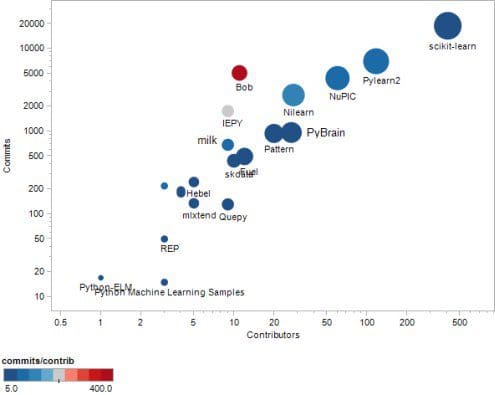
top-python-machine-learning-projects
Fig. 1: Python Machine learning projects on GitHub, with color corresponding to commits/contributors. Bob, Iepy, Nilearn, and NuPIC have the highest such value. 

  1. scikit-learn, 18845 commits, 404 contributors, 
    www.github.com/scikit-learn/scikit-learn 
    scikit-learn is a Python module for machine learning built on top of SciPy.It features various classification, regression and clustering algorithms including support vector machines, logistic regression, naive Bayes, random forests, gradient boosting, k-means and DBSCAN, and is designed to interoperate with the Python numerical and scientific libraries NumPy and SciPy.
  2. Pylearn2, 7027 commits, 117 contributors, 
    www.github.com/lisa-lab/pylearn2 
    Pylearn2 is a library designed to make machine learning research easy. Its a library based on Theano
  3. NuPIC, 4392 commits, 60 contributors, 
    www.github.com/numenta/nupic 
    The Numenta Platform for Intelligent Computing (NuPIC) is a machine intelligence platform that implements the HTM learning algorithms. HTM is a detailed computational theory of the neocortex. At the core of HTM are time-based continuous learning algorithms that store and recall spatial and temporal patterns. NuPIC is suited to a variety of problems, particularly anomaly detection and prediction of streaming data sources.
  4. Nilearn, 2742 commits, 28 contributors, 
    www.github.com/nilearn/nilearn 
    Nilearn is a Python module for fast and easy statistical learning on NeuroImaging data. It leverages the scikit-learn Python toolbox for multivariate statistics with applications such as predictive modeling, classification, decoding, or connectivity analysis.
  5. PyBrain, 969 commits, 27 contributors, 
    www.github.com/pybrain/pybrain 
    PyBrain is short for Python-Based Reinforcement Learning, Artificial Intelligence and Neural Network Library. Its goal is to offer flexible, easy-to-use yet still powerful algorithms for Machine Learning Tasks and a variety of predefined environments to test and compare your algorithms.
  6. Pattern, 943 commits, 20 contributors, 
    www.github.com/clips/pattern 
    Pattern is a web mining module for Python. It has tools for Data Mining, Natural Language Processing, Network Analysis and Machine Learning. It supports vector space model, clustering, classification using KNN, SVM, Perceptron
  7. Fuel, 497 commits, 12 contributors, 
    www.github.com/mila-udem/fuel 
    Fuel provides your machine learning models with the data they need to learn. it has interfaces to common datasets such as MNIST, CIFAR-10 (image datasets), Google's One Billion Words (text). It gives you the ability to iterate over your data in a variety of ways, such as in minibatches with shuffled/sequential examples
  8. Bob, 5080 commits, 11 contributors, 
    www.github.com/idiap/bob 
    Bob is a free signal-processing and machine learning toolbox The toolbox is written in a mix of Python and C++ and is designed to be both efficient and reduce development time. It is composed of a reasonably large number of packages that implement tools for image, audio & video processing, machine learning and pattern recognition
  9. skdata, 441 commits, 10 contributors, 
    www.github.com/jaberg/skdata 
    Skdata is a library of data sets for machine learning and statistics. This module provides standardized Python access to toy problems as well as popular computer vision and natural language processing data sets.
  10. MILK, 687 commits, 9 contributors, 
    www.github.com/luispedro/milk 
    Milk is a machine learning toolkit in Python. Its focus is on supervised classification with several classifiers available: SVMs, k-NN, random forests, decision trees. It also performs feature selection. These classifiers can be combined in many ways to form different classification systems.For unsupervised learning, milk supports k-means clustering and affinity propagation.
  11. IEPY, 1758 commits, 9 contributors, 
    www.github.com/machinalis/iepy 
    IEPY is an open source tool for Information Extraction focused on Relation Extraction 
    It's aimed at users needing to perform Information Extraction on a large dataset. scientists wanting to experiment with new IE algorithms.
  12. Quepy, 131 commits, 9 contributors, 
    www.github.com/machinalis/quepy 
    Quepy is a python framework to transform natural language questions to queries in a database query language. It can be easily customized to different kinds of questions in natural language and database queries. So, with little coding you can build your own system for natural language access to your database. 
    Currently Quepy provides support for Sparql and MQL query languages, with plans to extended it to other database query languages.
  13. Hebel, 244 commits, 5 contributors, 
    www.github.com/hannes-brt/hebel 
    Hebel is a library for deep learning with neural networks in Python using GPU acceleration with CUDA through PyCUDA. It implements the most important types of neural network models and offers a variety of different activation functions and training methods such as momentum, Nesterov momentum, dropout, and early stopping.
  14. mlxtend, 135 commits, 5 contributors, 
    www.github.com/rasbt/mlxtend 
    Its a library consisting of useful tools and extensions for the day-to-day data science tasks.
  15. nolearn, 192 commits, 4 contributors, 
    www.github.com/dnouri/nolearn 
    This package contains a number of utility modules that are helpful with machine learning tasks. Most of the modules work together with scikit-learn, others are more generally useful.
  16. Ramp, 179 commits, 4 contributors, 
    www.github.com/kvh/ramp 
    Ramp is a python library for rapid prototyping of machine learning solutions. It's a light-weight pandas-based machine learning framework pluggable with existing python machine learning and statistics tools (scikit-learn, rpy2, etc.). Ramp provides a simple, declarative syntax for exploring features, algorithms and transformations quickly and efficiently.
  17. Feature Forge, 219 commits, 3 contributors, 
    www.github.com/machinalis/featureforge 
    A set of tools for creating and testing machine learning features, with a scikit-learn compatible API. 
    This library provides a set of tools that can be useful in many machine learning applications (classification, clustering, regression, etc.), and particularly helpful if you use scikit-learn (although this can work if you have a different algorithm).
  18. REP, 50 commits, 3 contributors, 
    www.github.com/yandex/rep 
    REP is environment for conducting data-driven research in a consistent and reproducible way. It has a unified classifiers wrapper for variety of implementations like TMVA, Sklearn, XGBoost, uBoost. It can train classifiers in parallel on a cluster. It supports interactive plots
  19. Python Machine Learning Samples, 15 commits, 3 contributors, 
    www.github.com/awslabs/machine-learning-samples 
    A collection of sample applications built using Amazon Machine Learning.
  20. Python-ELM, 17 commits, 1 contributor, 
    www.github.com/dclambert/Python-ELM 
    This is an implementation of the Extreme Learning Machine in Python, based on scikit-learn.
This post used some content from www.pansop.com/1039/ 

What is feature engineering?

Just read a post from http://blog.bigml.com/2013/02/21/everything-you-wanted-to-know-about-machine-learning-but-were-too-afraid-to-ask-part-two/
What is Feature Engineering?
teachFeature Engineering is the Keyer_key
We’ll start out this time with a topic that is so important that it deserves an instructive example. In fact, Domingos calls it “easily the most important factor” in determining the success of a machine learning project, and I agree with him.
Suppose you have a dataset in which you have pairs of cities, coupled with a prediction of whether most people would consider the two cities to be comfortably drivable within a single day. You’ve got a nice database with the longitudes and latitudes for all of your cities, and so these are your input fields. Your dataset might look something like this (note that the values don’t correspond to actual city locations – they are random):
CITY 1 LAT.CITY 1 LNG.CITY 2 LAT.CITY 2 LNG.DRIVABLE?
123.2446.71121.3347.34Yes
123.2456.91121.3355.23Yes
123.2446.71121.3355.34No
123.2446.71130.9947.34No
And you expect to construct a model that can predict for any two cities whether the distance is drivable or not.
Probably not going to happen.
The problem here is that no single input field, or even any single pair of fields, is closely correlated with the objective. It is a combination of all four fields (the distance from one pair of geo-coordinates to the other), and a combination by a fairly complex formula, that is correlated with the input. Machine learning algorithms are limited in the way they can combine input fields; if they weren’t, they could totally exhaust themselves trying everything.
But all is not lost! Even if the machine doesn’t have any knowledge about how longitudes and latitudes work, you do. So why don’t you do it? Apply the formula to each instance and get a dataset like this (again, random values):
DISTANCE (MI.)DRIVABLE?
14Yes
28Yes
705No
2432No
Ah. Much more manageable. This is what we mean by feature engineering. It’s when you use your knowledge about the data to create fields that make machine learning algorithms work better.
Domingos mentions that feature engineering is where “most of the effort in a machine learning project goes”. I couldn’t agree more. In my career, I would say an average of 70% of the project’s time goes into feature engineering, 20% goes towards figuring out what comprises a proper and comprehensive evaluation of the algorithm, and only 10% goes into algorithm selection and tuning.
How does one engineer a good feature? One good rule of thumb is to try to design features where the likelihood of a certain class goes upmonotonically with the value of the field. So in our example above, “drivable = no” is more likely as distance increases, but that’s not true of longitude or latitude. You probably won’t be able to engineer a feature where this is strictly true, but it is a good feature even if it is somewhat close to that ideal.
Typically, there isn’t a single data transformation that makes learning immediately easy (as there was in the above example), but at least as typically there are one or more things you can do to the data to make machine learning easier. There’s no formula for this, and a lot of it happens by itch and by twitch. BigML attempts to do some of the easy ones for you (automated date parsing is an example) but far more interesting transformations can happen with detailed knowledge of your specific data. Great things happen in machine learning when human and machine work together, combining a person’s knowledge of how to create relevant features from the data with the machine’s talent for optimization.

On writing

Repost from http://terrytao.wordpress.com/advice-on-writing-papers/

There are three rules for writing the novel. Unfortunately, no one knows what they are. (W. Somerset Maugham)
Everyone has to develop their own writing style, based on their own strengths and weaknesses, on the subject matter, on the target audience, and sometimes on the target medium.  As such, it is virtually impossible to prescribe rigid rules for writing that encompass all conceivable situations and styles.
Nevertheless, I do have some general advice on these topics:
I should point out, of course, that my own writing style is not perfect, and I myself don’t always adhere to the above rules, often to my own detriment. If some of these suggestions seem too unsuitable for your particular paper, use common sense.
Dual to the art of writing a paper well, is the art of reading a paper well.  Here is some commentary of mine on this topic:
Some further advice on mathematical exposition:

Information Retrieval Surveys

This is a very useful list of surveys from Doug Oard, which would be definitely helpful for those who want to enter this territory. 

Information Retrieval Surveys

These surveys typically address a focused topic in the broad area of information retrieval. I have listed here surveys on topics that are clearly central to information retrieval; additional surveys on related topics can be found on the Web site of each series. Links to freely available versions are provided when available; others are available through Research Port at the University of Maryland Libraries.

Longer Surveys

These surveys are the length of short books, typically about 100 pages.

fairly comprehensive notes statistical NLP from Collins

Data Science in Python

Data Science in Python

by Greg


http://blog.yhathq.com/posts/data-science-in-python-tutorial.html?from=timeline&isappinstalled=0


a nice tutorial of data science for pythoners. 

SIGIR 2014 Accepted Short Papers List

SIGIR 2014 Accepted Short Papers List

NOTE to presenters: Posters are to be A0 portrait or smaller. That is, 841mm x 1189mm, or 33.1 inches x 46.8 inches.
Included here is a tentative list of the short papers. Titles and author lists are subject to change. Short papers will be presented as posters during the poster session.

•Search Result Diversification via Data Fusion
Shengli Wu
•Hashtag Recommendation for Hyperlinked Tweets
Surendra Sedhai, Aixin Sun
•Personalized Document Re-ranking Based on Bayesian Probabilistic Matrix Factorization
Fei Cai, Shangsong Liang, Maarten de Rijke
•Using the Cross-Entropy Method to Re-Rank Search Results
Haggai Roitman, Shay Hummel, Oren Kurland
•Computing and applying topic-level user interactions in microblog recommendation
Xiao Lu
•Towards Context-Aware Search with Right Click 
Aixin Sun, Chii-Hian Lou
•Rendering Expressions to Improve Accuracy of Relevance Assessment for Math Search
Matthias Reichenbach, Richard Zanibbi, Anurag Agarwal
•Exploring Recommendations in Internet of Things
Lina Yao, Quan Z. Sheng, Anne H. Ngu, Helen Ashman, Xue Li
•Sig-SR: SimRank Search over Singular Graphs
Yu Weiren
•Old Dogs Are Great at New Tricks: Column Stores for IR Prototyping
Hannes Muhleisen, Thaer Samar, Jimmy Lin, Arjen P. de Vries
•The Role of Network Distance in LinkedIn People Search 
Shih-Wen Huang, Daniel Tunkelang, Karrie Karahalios
•Latent Community Discovery Through Enterprise User Search Query Modeling
Kevin Carter, Rajmonda Caceres, Ben Priest
•Examining Collaborative Query Reformulation: A Case of Travel Information Searching
Abu Shamim Mohammad Arif, Jia Tina Du, Ivan Lee
•Influential Nodes Selection: A Data Reconstruction Perspective
Zhefeng Wang, Hao Wang, Qi Liu, Enhong Chen
•A Fusion Approach to Cluster Labeling
Haggai Roitman, Shay Hummel, Michal Shmueli-Scheuer
•Evaluating the Effort Involved in Relevance Assessments for Images
Martin Halvey, Robert Villa
•Diversifying Query Suggestions Based on Query Documents
Youngho Kim, Bruce Croft
•Comparing Client and Server Dwell Time Estimates for Click-Level Satisfaction Prediction
Youngho Kim, Ahmed Hassan, Ryen W. White, Imed Zitouni
•Score-Safe Term Dependency Processing with Hybrid Indexes
Matthias Petri, Alistair Moffat, Shane Culpepper
•Co-Training on Authorship Attribution with Very Few Labeled Examples: Methods vs. Views
Tieyun Qian, Bing Liu, Ming Zhong, Guoliang He
•Probabilistic Text Modeling with Orthogonalized Topics
Enpeng Yao, Guoqing Zheng
•Evaluating non-deterministic retrieval systems
Gaya Jayasinghe, William Webber, Mark Sanderson, Lasitha Dharmasena, Shane Culpepper
•Extending test collection pools without manual runs
Gaya Jayasinghe, William Webber, Mark Sanderson, Shane Culpepper
•The Search Duel: A Response to a Strong Ranker
Peter Izsak, Fiana Raiber, Oren Kurland, Moshe Tennenholtz
•Predicting Previous Version of a Product Entity
Priya Radhakrishnan, Manish Gupta, Vasudeva Varma
•Predicting Burst and Popularity of Hashtags in Real-Time
Shoubin Kong
•Probabilistic Ensemble Learning for Vietnamese Word Segmentation
Wuying Liu, Li Lin
•Improving Unsupervised Query Segmentation using Parts-of-Speech Sequence Information
Rishiraj Saha Roy, Yogarshi Vyas, Niloy Ganguly, Monojit Choudhury
•Building a Query Log via Crowdsourcing
Omar Alonso, Maria Stone
•Web Search without 'Stupid' Results
Aleksandra Lomakina, Nikita Povarov, Pavel Serdyukov
•Discovering Real-World Use Cases for a Multimodal Math Search Interface
Keita Del Valle Wangari, Richard Zanibbi, Anurag Agarwal
•Improving Search Personalisation with Dynamic Group Formation
Thanh Vu, Dawei Song, alistair willis, Son N. Tran
•Detection of Abnormal Profiles on Group attacks in Recommender Systems
Wei Zhou, Yun Sing Koh, Junhao Wen, Shafiq Alam, Gillian Dobbie
•On Run Diversity in "Evaluation as a Service"
Ellen Voorhees, Jimmy Lin, Miles Efron
•Evaluating Answer Passages using Summarization Measures
Mostafa Keikha, Jae Hyun Park, Bruce Croft
•Analyzing Bias in CQA-based Expert Finding Test Sets
Reyyan Yeniterzi, Jamie Callan
•Understanding Negation and Family History to Improve Clinical Information Retrieval
Bevan Koopman, Guido Zuccon
•Modeling Dual Role Preferences for Trust-aware Recommendation
Weilong Yao, Jing He, Guangyan Huang, Yanchun Zhang
•Mouse Movement During Relevance Judging: Implications for Determining User Attention
Mark D Smucker, Xiaoyu Guo, Andrew Toulis
•PAAP: Prefetch-Aware Admission Policies for Query Results Cache in Web Search Engines
Hongyuan Ma
•User Geospatial Context for Music Recommendation in Microblogs
Markus Schedl, Andreu Vall, Katayoun Farrahi
•Compositional Data Analysis (CoDA) approaches to distance in information retrieval
Paul Thomas, David Lovell
•Group Latent Factor Model for Recommendation with Multiple User Behaviors
Jian Cheng, Ting Yuan, Hanqing Lu
•Hashing with List-wise Learning to Rank
Zhou Yu, Fei Wu, Siliang Tang, Yin Zhang, Jian Shao, Yueting Zhuang
•A Burstiness-aware Approach for Document Dating
Dimitrios Kotsakos, Theodoros Lappas, Dimitrios Kotzias, Dimitrios Gunopulos, Nattiya Kanhabua, Kjetil Norvag
•An Analysis of Query Difficulty for Information Retrieval in the Medical Domain
Lorraine Goeuriot, Liadh Kelly, Johannes Leveling
•Mobile Query Reformulations
Milad Shokouhi, Rosie Jones, Umut Ozertem, Karthik Raghunathan, Fernando Diaz
•On Peculiarities of Positional Effects in Sponsored Search
Vyacheslav Alipov, Valery Topinsky, Ilya Trofimov
•A Collective Topic model for Milestone Paper Discovery
Ziyu Lu, Nikos Mamoulis, David Cheung
•Document Summarization Based on Word Associations
Oskar Gross, Hannu Toivonen, Antoine Doucet
•Do Users Rate or Review? Boost Phrase-level Sentiment Analysis by Review Sentiment Classification
Kun Zhang
•Random Subspace for Binary Codes Learning in Large Scale Image Retrieval
Cong Leng, Jian Cheng, Hanqing Lu
•Incorporating Query-Specific Feedback into Learning-to-rank Models
Ethem F. Can, Bruce Croft, R. Manmatha
•Large-Scale Author Verification: Temporal and Topical Influences
Michiel van Dam, Claudia Hauff
•Evaluating Mobile Web Search Performance by Taking Good Abandonment into Account
Olga Arkhipova, Lidia Grauer
•Assessing the Usability and Reusability of an E-Discovery Privilege Test Collection
Jyothi Vinjumur, Douglas W Oard, Jiaul Paik
•Modeling Evolution of a Social Network using Temporal Graph Kernels
Akash Anil, Niladri Sett, Ranbir Sanasam
•On User’s Interactions with Query Auto-Completion
Bhaskar Mitra, Milad Shokouhi, Filip Radlinski, Katja Hofmann
•Re-ranking Approach to Classification in Large-scale Power-law Distributed Category Systems
Rohit Babbar, Ioannis partalas, Eric Gaussier, Massih Reza Amini
•Enhancing Personalization via Search Activity Attribution
Adish Singla, Ryen W. White, Ahmed Hassan, Eric Horvitz
•A Syntax-Aware Re-ranker for Microblog Retrieval
Aliaksei Severyn, Alessandro Moschitti, Manos Tsagkias, Richard Berendsen, Maarten de Rijke
•Weighted Aspect-Based Collaborative Filtering
YanPing Nie, Yang Liu, Xiaohui Yu
•Evaluating Intuitiveness of Vertical-Aware Click Models
Aleksandr Chuklin, Ke Zhou, Anne Schuth, Floor Sietsma, Maarten de Rijke
•Recipient Recommendation in Enterprises using Social Graphs and Email Content
David Graus, David van Dijk, Manos Tsagkias, Wouter Weerkamp, Maarten de Rijke
•Analyzing the Content Emphasis of Web Search Engines
Mohammed Alam, Doug Downey
•Effects of Task and Domain on Searcher Attention and Cognitive Load
Dmitry Lagun, Eugene Agichtein
•Learning Sufficient Queries for Entity Filtering
Miles Efron, Craig Willis, Garrick Sherman
•PatentLine: Analyzing Technology Evolution on Multi-View Patent Graphs
Longhui Zhang, Lei Li, Tao Li
•Query Performance Prediction for Entity Retrieval
Hadas Raviv, Oren Kurland, David Carmel
•Second order probabilistic models for Within-Document Novelty Detection in Academic Articles
Laurence Park, Simeon Simoff
•Modeling the Dynamics of Personal Expertise
Yi Fang, Archana Godavarthy
•Annotation Similarity Model in Passage Ranking for Historical Fact Validation
Jun Araki, Jamie Callan
•To Tip or not to Tip: Exploring the Effectiveness of Search Hints for Complex Informational Tasks
Denis Savenkov, Eugene Agichtein
•The Effect of Sampling Strategy on Inferred Measures
Ellen Voorhees
•Cache-Conscious Runtime Optimization for Ranking Ensembles
Xun Tang, Xin Jin, Tao Yang
•Bridging Temporal Context Gaps using Time-Aware Re-Contextualization
Andrea Ceroni, Nam Khanh Tran, Nattiya Kanhabua, Claudia Niederee
•An Enhanced Context-sensitive Proximity Model for Probabilistic Information Retrieval
Jiashu Zhao, Jimmy Huang
•On the Information Difference between Standard Retrieval Models
Peter B. Golbus, Javed A Aslam
•A POMDP Model for Content-Free Document Re-ranking
Sicong Zhang, Jiyun Luo, Grace Hui Yang
•Clustering Search Results for Diversification Using Score Differences
Sadegh Kharazmi, David Vallet, Falk Scholer, Mark Sanderson
•TREC: Topic engineeRing ExerCise
Shane Culpepper, Stefano Mizzaro, Mark Sanderson, Falk Scholer
•How K-12 Students Search For Learning? Analysis of an Educational Search Engine Log
Arif Usta, Ismail S Altingovde, Bahattin Vidinli, Rifat Ozcan, Ozgur Ulusoy
•The Correlation between Cluster Hypothesis Tests and the Effectiveness of Cluster-Based Retrieval
Fiana Raiber, Oren Kurland
•The Effect of Expanding Relevance Judgements with Duplicates
Gaurav M Baruah, Adam Roegiest, Mark D Smucker
•On Correlation of Absence Time and Search Effectiveness
Sunandan Chakraborty, Filip Radlinski, Milad Shokouhi, Paul Baecke
•Necessary and Frequent Terms in Queries 
Jiepu Jiang, James Allan
•Extracting Topics Based on Authors, Recipients and Content in Microblogs
Nazneen Fatema Rajani, Kate McArdle
•Exploiting Twitter and Wikipedia for the Annotation of Event Images
Philip McParlane, Joemon Jose
•Learning to Translate Queries for CLIR
Artem Sokolov, Felix Hieber, Stefan Riezler
•Predicting Query Performance In Microblog Retrieval
Jesus Alberto Rodriguez Perez
•An Event Extraction Model based on a Timeline and User Reliability Analysis on Twitter
Bayar Tsolmon, Kyung-Soon Lee
•What Makes Data Robust: A Data Analysis in Learning to Rank
Shuzi Niu, Yanyan Lan, Jiafeng Guo, Xueqi Cheng, Xiubo Geng
•Learning to Bridge Colloquial and Formal Language Applied to Linking and Search of E-Commerce Data
Ivan Vulic, susana zoghbi, Marie-Francine Moens
•Uncovering the Unarchived Web
Thaer Samar, Hugo C. Huurdeman, Anat Ben-David, Jaap Kamps, Arjen P. de Vries
•Inferring Topic-Dependent Influencing Roles of Twitter Users
Chengyao Chen, Dehong Gao, Wenjie Li
•Reputation Analysis with a Ranked Sentiment-Lexicon
Filipa Peleja, Joao Santos, Joao Magalhaes
•On Predicting Religion Labels in Microblogging Networks
Minh-Thap Nguyen, Ee-Peng Lim
•Efficiently Identify Local Frequent Keyword Co-occurrence Patterns in Geo-tagged Twitter Stream
Xiaoyang Wang, Ying Zhang, Wenjie Zhang, Xuemin Lin
•Item Group Based Pairwise Preference Learning for Personalized Ranking
Qiu Shuang, Jian Cheng, Ting Yuan, Cong Leng, Hanqing Lu
•Where Not to Go? Detecting Road Hazards Using Twitter
Yi Fang, Avinash Kumar, Miao Jiang
•Enhancing Sketch-based Sport Video Retrieval by Suggesting Relevant Motion Paths
Ihab Al Kabary, Heiko Schuldt
•Dynamic Location Models
Vanessa Murdock
•Wikipedia-Based Query Performance Prediction
Gilad Katz, Anna Shtok, Oren Kurland, Bracha Shapira, Lior Rokach
•A Revisit to Social Network-Based Recommender System
Hui Li, Dingming Wu, Nikos Mamoulis

Popular Posts